
New gutters are not an accessory bolted to the edge of your roof. We engineer the full run, from the drip edge to the splash block, so every Indiana downpour, snowmelt, and spring storm lands well past your foundation instead of against it.
Fast. Accurate. Transparent.
By submitting, you agree to our Privacy Policy.
A gutter system only works if every part is sized, pitched, and anchored as one. At Alpha Holistic Roofing we approach rain gutter installation the way we approach a roof: we map exactly how water sheds off each plane, calculate the runoff volume, and then build a continuous path that carries it clear of your fascia, masonry, and basement. That is the difference between gutters that look fine on day one and gutters that still drain correctly after five Indianapolis freeze-thaw winters. This page focuses narrowly on the install itself; for the full water-management picture, see our Gutter Systems pillar.
We install new gutters on new construction, replace failing sectional runs, and add seamless gutters to finish a fresh roof across the metro, from Carmel and Fishers to Greenwood, Avon, and Zionsville. Every project starts with measurement and a written estimate, ends with a live water test, and is engineered to handle the heavy, fast runoff our region's storms produce. When we pair the work with roof installation & replacement, we tie the drip edge, kickout flashing, and gutters into one watertight edge.
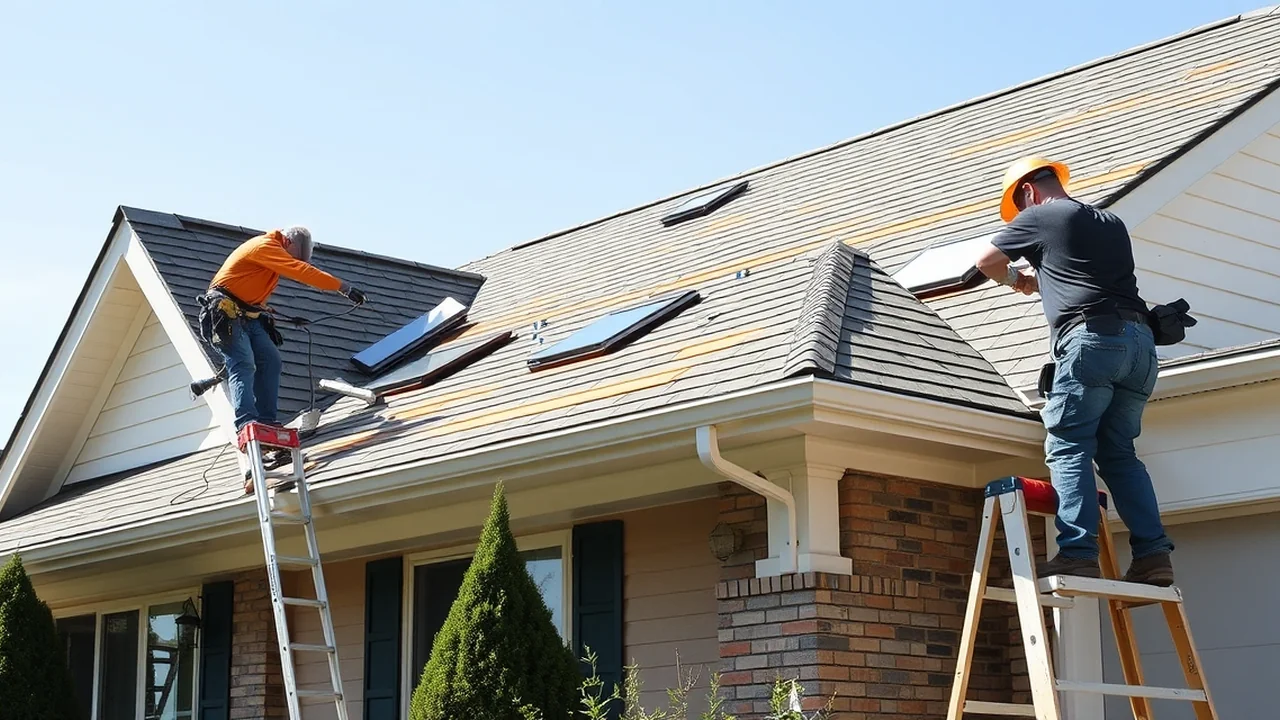
The right system depends on your roof area, pitch, and trim. Here are the core choices we size and recommend during a gutter installation.
Standard 5-inch K-style suits most Indianapolis homes, but steep or large roof planes shed water faster than a 5-inch trough can carry. We spec 6-inch oversized gutters with larger 3x4 downspouts when the runoff math calls for it, so water never overshoots in a hard rain.
Our machine forms continuous seamless aluminum gutters at your home, so the only joints are the corners and outlets. No mid-run seams means far fewer leak points through freeze-thaw. See the full lineup on our Seamless Gutters page.
K-style holds more water and complements most modern and traditional Indianapolis homes. Half-round suits historic and high-end properties, especially in copper. We match profile, color, and trim so the gutters read as part of the house, not an add-on.
A trough is only as good as where it dumps. We size gutters and downspouts together, add extensions, splash blocks, or underground drain tie-ins, and route discharge far enough out to keep your foundation and landscaping dry.
Installing fresh runs is the ideal moment to add gutters with leaf guard protection. Micro-mesh and reverse-curve gutter guards keep Indiana's leaves and maple helicopters out and slow ice-dam buildup at the eave.
Putting up gutters correctly is a sequence, not a single step. We diagnose the water path first, form the runs on-site, then prove the system works before we leave. Here is exactly how a gutter installation runs from start to sign-off.
Most gutter failures we replace in Indianapolis are not worn-out metal, they are install errors: too little slope, downspouts too small for the roof area, or hangers spaced too far apart to hold a loaded, ice-laden run in February.
We engineer those numbers up front and back the workmanship with a written warranty alongside the manufacturer's material coverage, so the system you pay for is the system that performs.

Two houses on the same Indianapolis street rarely need the same system. Roofline length, number of stories, material, and drainage complexity all move the number. Here is how we match the build to the property and the budget.
Seamless aluminum is the best value for most local homes: rust-free, available in dozens of baked-on colors, and durable through hard winters. Copper is a premium, decades-long choice for historic and high-end properties. Vinyl is the lowest cost but turns brittle in deep cold, so we reserve it for mild, low-runoff situations.
Cost tracks linear footage, the number of stories and ladder setups, profile and material, and whether you add downspouts or guards. A simple single-story ranch runs far less than a steep, cut-up two-story roofline. We measure on-site and put every line item in a written estimate, so there are no surprises.
We serve both. Residential runs are usually 5-inch or 6-inch K-style. Larger Indianapolis commercial roofs need oversized 6-inch, box gutters, or conductor-head systems to move the volume, which we coordinate with flat & low-slope roofing so the whole building drains as one.
Replacing the roof at the same time? Doing roof and gutter installation together lets us integrate drip edge, kickout flashing, and seamless runs into one watertight edge, and saves a second mobilization. Start at our Gutter Systems pillar to plan the combined project.
A gutter installation rarely stands alone. The water it collects starts at the roof edge and ends at your foundation, so the strongest projects connect those dots. If the roof edge itself is failing, begin with our Gutter Systems pillar and let us tie new gutters into a fresh roof installation & replacement in one pass. Because runoff that overshoots a gutter lands on your walls, we also pair fresh runs with siding & exterior wall protection and fascia or soffit work under exterior enhancements, so the entire envelope sheds water the way it should. Call (219) 221-9617 to scope your project.
Licensed, insured, and OSHA-compliant, with manufacturer-backed materials and a 4.9/5 rating from 500+ neighbors. We engineer systems, not patchwork, and we put it in writing.
“Our builder's gutters were undersized and overflowed every storm. Alpha re-ran the whole edge in seamless 6-inch with bigger downspouts and water-tested every run. First heavy rain after, not a drop spilled over. Clear written quote, no upsell.”
Daniel K., Westfield
“They installed new gutters when we replaced our roof and showed me how the drip edge and gutters tie together. The crew added leaf guards so I'm done on the ladder every fall. Tidy job, honest pricing, finished in a day.”
Alyssa M., Brownsburg
“Two estimators just quoted standard 5-inch. Alpha actually measured the roof, explained why our steep back slope needed 6-inch with a 3x4 downspout, and routed the discharge away from the patio. The overflow we lived with for years is finally gone.”
Reginald T., Greenwood
Most residential seamless gutter installations in the Indianapolis area run between $1,200 and $3,500, depending on linear footage, number of stories, material, and whether you add downspouts or guards. A simple single-story ranch sits at the low end; a steep, cut-up two-story roofline costs more. We measure on-site and give a clear written estimate so there are no surprises.
It depends on roof area and pitch, not just the size of the house. Standard 5-inch K-style handles most Indianapolis homes, but steep or large roof planes shed water fast enough to overflow a 5-inch trough. In those cases we spec 6-inch gutters with larger 3x4 downspouts. We run the runoff math during the estimate and size the whole system to it.
Most single-family homes are a one-day job. Because we form the seamless runs on-site, there is no waiting on prefabricated sections. Larger or multi-story homes, copper systems, and projects that include gutter guards or extensive downspout drainage can take a second day. We confirm the timeline in your written estimate.
Yes, we recommend it. Doing roof and gutter installation together lets us integrate the drip edge, kickout flashing, and gutters into one watertight edge, which prevents the water intrusion that happens when gutters are added later as an afterthought. It also saves a second mobilization and ladder setup, which keeps the combined cost down.
For a new installation, yes. Sectional gutters have a joint every few feet, and those seams are exactly where leaks, rust, and clogs start. Seamless runs are machine-formed on-site as one continuous piece per side, with joints only at the corners and outlets. They leak far less and hold up better through Indiana's freeze-thaw cycles.
Far enough from the house to protect the foundation. A gutter is only as good as where it dumps, so we size the downspouts to the run, then add extensions, splash blocks, or underground drain tie-ins that carry runoff well past the foundation and out of flower beds. Poor discharge is one of the most common causes of wet basements we see in the metro.