
A bright white, heat-welded thermoplastic membrane engineered for your flat or low-slope roof. We don't roll out a loose sheet and hope, we weld a continuous TPO roofing membrane that reflects Indiana's summer sun, seals every seam, and holds tight through freeze-thaw winters.
Fast. Accurate. Transparent.
By submitting, you agree to our Privacy Policy.
Thermoplastic polyolefin, or TPO, has become the most-installed flat-roof membrane in the country for one reason: a white reflective surface welded into a single continuous sheet. The strength of a tpo roof membrane lives in its seams, and unlike taped rubber, TPO seams are fused with hot air into a bond that is often stronger than the sheet itself. That is exactly where most flat roofs fail, so it is exactly where we focus. TPO is one of three families inside our single-ply roofing systems lineup, spec'd to the building rather than sold off a truck.
Across Indianapolis, a white tpo roof does real work in July, bouncing solar heat off Meridian-Kessler warehouses, Broad Ripple storefronts, and modern low-slope homes so the HVAC system runs less. We install tpo commercial roofing on large decks and tpo roofing residential sections on additions and flat-roofed houses to the same welded standard. Because TPO is one layer of a larger envelope, the membrane choice always fits inside our broader flat and low-slope roofing systems approach, never a one-size pitch.
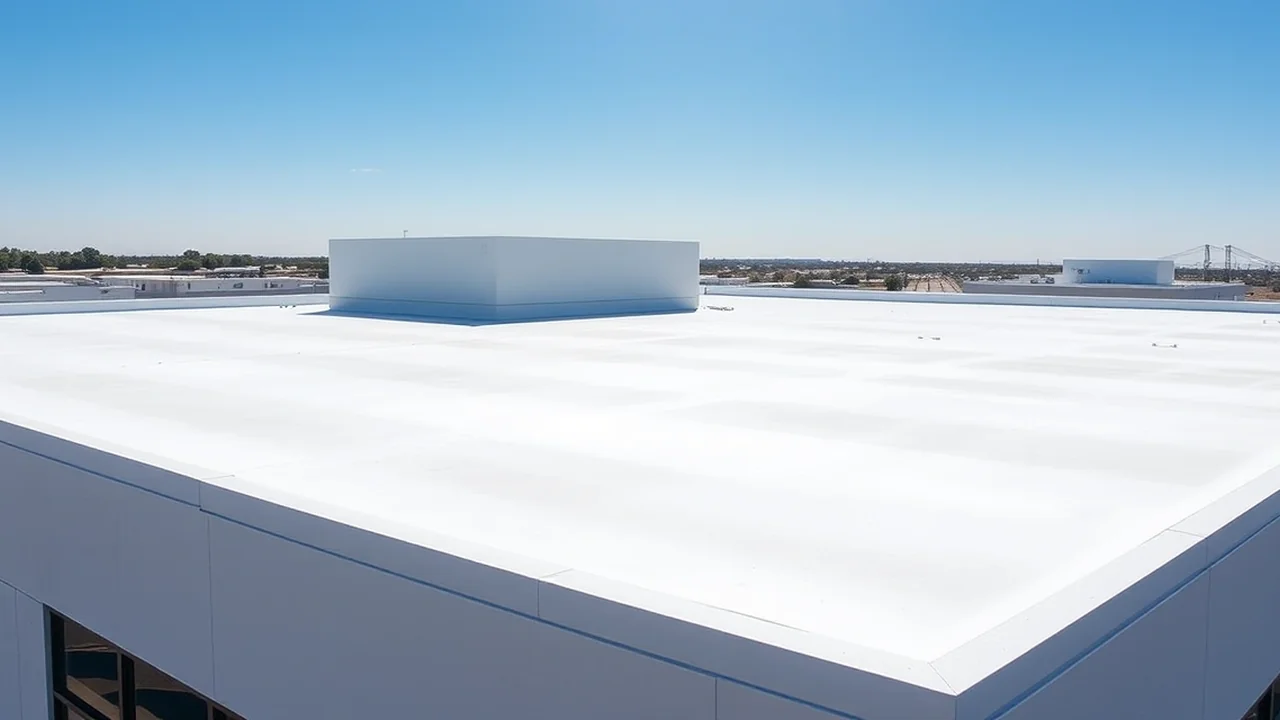
TPO is not one product. Thickness, attachment, and color all change how the membrane performs on your Indianapolis roof, and we match each to your building and climate exposure.
TPO comes in 45, 60, and 80 mil thicknesses. We typically spec 60 mil for Indianapolis commercial decks as the value-to-durability sweet spot, stepping up to 80 mil where foot traffic, hail exposure, or warranty length demands it. Thicker membrane means more weatherable surface above the scrim and a longer service life.
How the tpo membrane roof attaches to the deck changes everything. Fully-adhered gives a smooth, wind-rated finish; mechanically-fastened is fast and cost-effective for large warehouse footprints; ballasted holds the sheet with stone. We engineer the method to your roof's wind zone, deck type, and budget.
A white tpo roof delivers the maximum reflectivity that makes TPO famous, ideal for cutting Indianapolis cooling load. Gray and black tpo roofing are available where reflectivity is not the goal or aesthetics matter on a visible low-slope section. Color is an energy decision, and we frame it against your insulation and HVAC.
Every seam is fused with a hot-air welder and probe-tested, then we detail pipes, curbs, drains, and parapets with pre-molded TPO accessories. Proper tpo installation lives in the transitions, the flashings and terminations where a loose lap would otherwise let water in.
An aging or punctured membrane does not always mean a tear-off. We handle tpo roofing repair, weld in patches, re-terminate edges, and apply a tpo roof coating to restore reflectivity and add years, often re-covering over the existing system to skip the cost of full removal.
A TPO roof is only as good as the deck beneath it, the insulation that sets the R-value, and the welds that close it. Our holistic process treats the membrane as one engineered assembly, deck to terminations, so a white sheet does not just look new but actually performs as a continuous, watertight system through Indiana's worst weather.
Most TPO failures trace back to a cold weld, an under-detailed flashing, or a penetration that was rushed. We weld, probe-test, and re-terminate every transition so the membrane stays continuous from field to edge, the way a thermoplastic roof is supposed to perform.
Not sure whether your Indianapolis flat roof needs a new TPO membrane, a coating, or just a repair? Call the holistic roofing team at (219) 221-9617 and we will spec the honest path for your building.
TPO is the value leader among welded single-ply membranes, but the final number depends on the system you build under and over it. Here is how we frame the decision for Indianapolis flat and low-slope roofs.
Most TPO projects in the Indianapolis metro land between roughly 5.50 and 9.50 dollars per square foot installed. The big drivers are membrane thickness (45 vs 60 vs 80 mil), attachment method, insulation thickness, roof access, and how much tear-off or deck repair is needed. A re-cover over a sound existing roof costs far less than a full tear-off. We provide an itemized estimate after a free on-site inspection, never a phone guess.
A properly welded TPO roofing membrane typically delivers 20 to 30 years in the Indianapolis climate. Thicker 60 and 80 mil sheets and clean, probe-tested seams push toward the upper end, while freeze-thaw cycling and summer UV punish any roof with cold welds or no maintenance. The membrane lasts as long as its seams and terminations do, which is why our welds, not the sheet alone, carry the lifespan.
TPO is the energy and value play: white reflectivity plus welded seams at a mid-range price. EPDM rubber roofing wins on cold-weather flexibility and budget but uses taped seams, while PVC roofing membrane carries the strongest welds and best grease and chemical resistance for restaurants and industrial decks. We will tell you honestly which membrane fits your building before quoting any of them.
Aging membranes often qualify for restoration through our roof coatings and protective systems instead of a tear-off, and the right TPO color ties directly into our energy efficiency roofing enhancements. We will tell you honestly which path makes sense for your roof.
A welded TPO roofing membrane protects warehouses, retail centers, restaurants, and modern low-slope homes from Carmel and Fishers to Zionsville, Noblesville, and Greenwood. Because TPO is one membrane within a larger system, we tie it back to the rest of your envelope: it sits inside our single-ply roofing systems pillar alongside EPDM rubber roofing and PVC roofing membrane, and when a seam opens up between scheduled work we deploy storm and emergency roofing for active leaks. That is the Envelope Approach, systems over patches, from the deck to the last welded seam.
Licensed, insured, and OSHA-compliant, with manufacturer-backed materials and a 4.9/5 rating from 500+ neighbors. We engineer systems, not patchwork, and we put it in writing.
“We re-covered our distribution center with 60 mil white TPO and the difference in the building during August was real, the warehouse stayed cooler and the AC stopped running flat out. Alpha welded every seam and probe-tested the laps in front of our facilities manager. No more chasing leaks.”
Derrick H., Fishers
“Our low-slope addition kept leaking at the old patched seams. Alpha pulled the failing membrane, fixed the deck, and welded down a clean white TPO sheet. They walked us through 45 versus 60 mil instead of just upselling, and the upstairs rooms are noticeably cooler now.”
Allison M., Noblesville
“They quoted TPO when two other companies pushed a full tear-off we did not need. Alpha re-covered over the sound roof, saved us thousands, and detailed every rooftop unit perfectly. Honest crew that clearly knows flat roofs.”
Victor S., Zionsville
A properly installed TPO roofing membrane typically lasts 20 to 30 years in the Indianapolis climate. The biggest factors are membrane thickness and seam quality: thicker 60 or 80 mil sheets and clean, probe-tested hot-air welds reach the upper end of that range, while freeze-thaw cycling and summer UV shorten the life of any roof with cold welds or no maintenance. Because TPO lasts only as long as its seams and terminations, we focus on the welds and flashings rather than just rolling out the sheet.
Most TPO projects in the Indianapolis metro fall between roughly 5.50 and 9.50 dollars per square foot installed. The cost depends on membrane thickness (45, 60, or 80 mil), the attachment method, insulation thickness, roof access, and how much tear-off or deck repair is required. A re-cover over a sound existing roof costs significantly less than a full tear-off. We provide a transparent, itemized estimate after a free on-site inspection instead of a number over the phone.
We most often spec 60 mil TPO for Indianapolis commercial roofs as the best balance of durability and cost, since the thicker weathering surface above the reinforcing scrim resists hail and foot traffic better than 45 mil. We step up to 80 mil where there is heavy rooftop traffic, severe hail exposure, or a longer manufacturer warranty target. 45 mil can make sense on simpler, low-traffic residential or budget projects. We match the thickness to how the roof will actually be used.
Yes. A white TPO roof is highly reflective and bounces a large share of solar heat away rather than absorbing it, which lowers rooftop temperature and cuts cooling load during Indianapolis summers. That makes white TPO one of the most popular cool-roof choices for both commercial decks and low-slope homes. Black and gray TPO are available where reflectivity is not the goal. The real savings depend on your insulation and HVAC, which is why we tie color into our energy efficiency roofing enhancements.
Absolutely. TPO is an excellent choice for residential flat and low-slope sections such as additions, porch roofs, dormers, and modern flat-roof homes. White TPO is especially popular on homes for its energy savings. We weld and terminate residential TPO to the same standard as our commercial work, so a small flat section never becomes the leak that damages the rest of the house. It pairs well with a sloped shingle or metal roof on the same home.
Most TPO problems are repairable. Punctures, seam separation, failed flashings, and edge shrinkage can usually be heat-welded or patched, and a targeted TPO repair or a fresh TPO roof coating often adds several years before a re-cover is needed. Replacement makes more sense when the membrane is widely brittle, the field is saturated with trapped moisture, or repairs are stacking up year after year. We core-sample questionable decks and tell you honestly whether to repair, recoat, or replace.
TPO seams are fused with a hot-air welder that melts the two membrane sheets together into a single continuous bond, which is typically stronger than the sheet itself. This is the key advantage over taped or adhered rubber seams that can peel over time. Because flat roofs almost always fail at a seam, flashing, or penetration rather than in the open field, we probe-test the full length of every weld and detail each transition to manufacturer spec so the membrane stays watertight and warranty-eligible.